Today we had an option of riding a “short” straight route from Pensacola to Milton, Florida, or a “longer” route, that took us onto old highway 90 and then through Blackwater Heritage State Trail, adding about 22 additional miles to the shorter route. I opted for the longer route, leaving at 8:00am and arriving at camp around 12:45pm, just in time to help set up tents and grab a shower and do some writing before dinner. The day was absolutely pristine, starting in the low 50’s but finishing in the mid to high 70’s, with very little clouds and wind. The route out of Pensacola was interesting, taking us along a ridge overlooking the Gulf, giving us an appreciation of just how expansive Pensacola is. While the population of Pensacola proper is listed at just slightly higher than 50,000 people, the entire metropolitan area lists a population of just a little more than 520,000. Some of the homes overlooking the Gulf were quite impressive, as were the long labyrinth of bike trails, which are well maintained and extremely helpful when navigating through the city and outskirts of town.
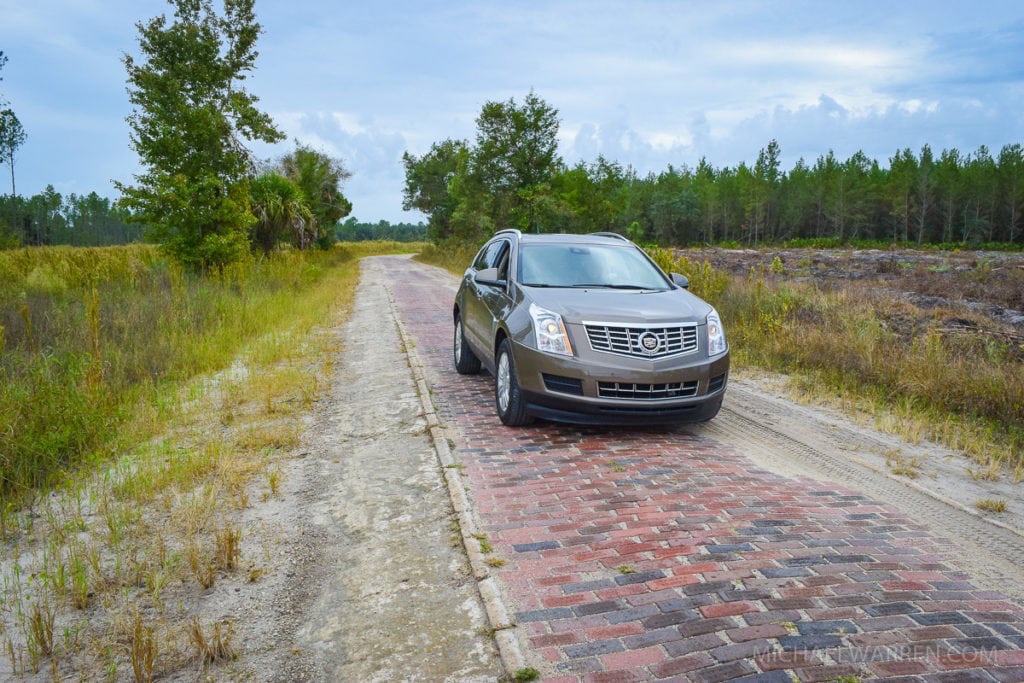
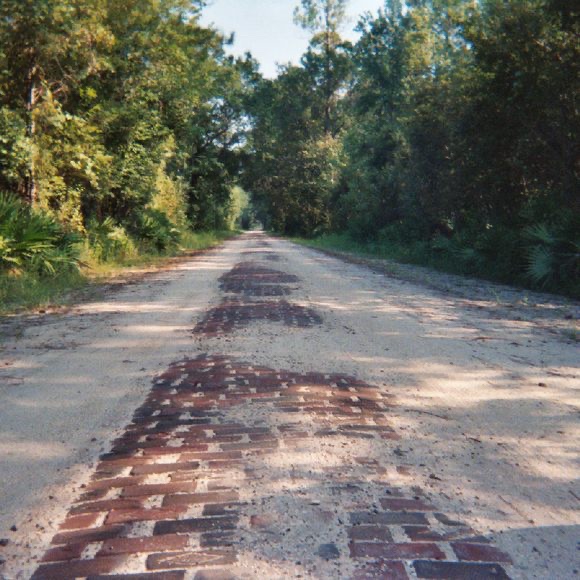
The Blackwater Heritage State Trail winds through heavily wooded countryside and through the town of Milton. One of the highlights for today was in experiencing Florida’s Old Brick Road, also known as the Dixie Highway. Built in the 1920’s, the Old Brick Road was a part of the Dixie Highway project, that brought together private industry and state governments to create a network of paved roads from Chicago to South Florida. The project head was a guy named Carl Fisher, who had previously created the Indianapolis Motor Speedway, (which is known as the “old brickyard”). At the time, the network connected 10 states with more than 5,000 miles of paved road. I paralleled a 10 mile stretch of the Old Dixie Highway, which still exists today. Back in the 1920’s, Model T’s and “Tin Can Trailers” often traveled this road, bringing tourists to the Sunshine state. The road is only 9 feet wide, and is wide enough for only one car. The stretch I paralleled once connected Jacksonville to Flagler Beach, through very small turpentine and potato farming communities. Some of the bricks are still marked with the words “Graves B’Hamala”, indicating that the bricks were produced by the Graves Brick Company in Birmingham, Alabama. (Reportedly, we will see some of these bricks in the streets of St. Augustine).

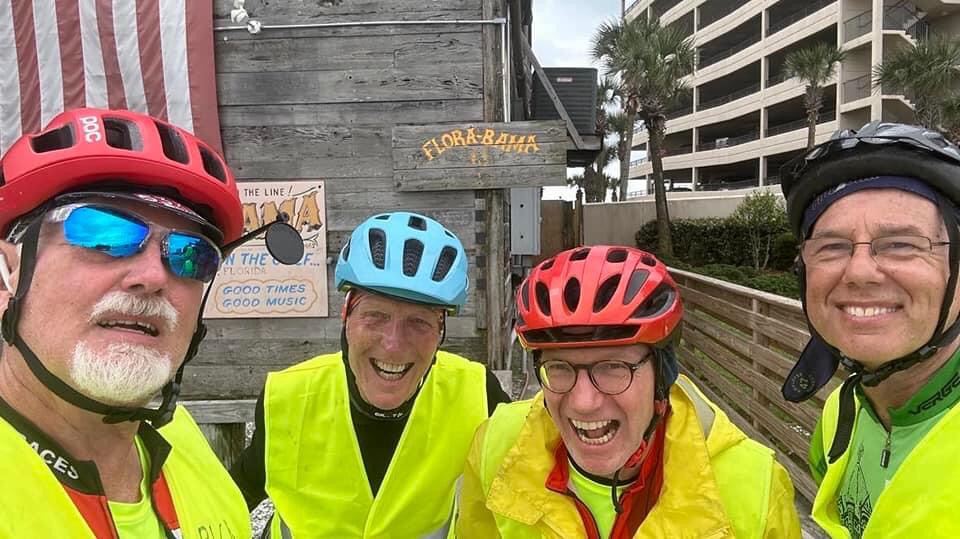
With the end of the tour only a week away, you can feel the excitement building with the people here. That being said, we have a minimum of 370+ miles left in our journey, so I’m trying to remain patient and focused on the next mile and next hour, instead of thinking about the final day. There have been some bikes that have experienced some significant problems, and as we have seen, a sudden turn of events can lead to an injury to a person or bike, changing the fate of any of us. As an example, poor Piet experienced some damage to his derailleur, to the point that his bike would not change gears, forcing him to ride in only one, very low gear. From a distance, he looks like a little kid on a tricycle, pedaling furiously as fast as he can in order to keep the front tire pointed in the right direction. The mechanic worked throughout the night to rectify the problem, and was, to his credit, able to allow Piet to change from the small chainring to the large, giving him a whopping TWO gears to choose from. Lance the mechanic says that Piet’s bike needs some significant repairs, which may or may not be able to happen in the next few days. Piet is undeterred, however, and vows to continue moving forward, albeit at a very slow pace.
We are currently staying in tents at the KOA (Kampgrounds of America) in Milton, FL. Milton, with a population of slightly more than 10,000 people, is the home of the Naval Air Station Whiting Field. Historically, Milton was known by various names during its development, the most notable being “Hell Town”, for its muggy weather, inhospitable land covered with briars, mosquitoes, thorns, and snakes. How would you like to work for the Chamber of Commerce here, huh? Fortunately, at some point, the name was changed to Milton, since the town centered on the lumber industry, and provided a “mill” to process the wood. During the Civil War, much of Milton was burned by the Confederate forces retreating from the Union capture of Pensacola in 1862. The Confederates intended to prevent the town’s industries from falling into Union hands. In World War II, Naval Air Station Whiting Field was constructed with the help of many German prisoners of war who were housed in a camp on the site. Though fairly small, there have been a number of well-known people who have graduated from Milton High School, including Bubba Watson, professional golfer on the PGA tour and two-time Master’s champion. Along with a half-dozen pro football players and a few other golfers, I’m told that Dayton Hobbs, a pastor of a Bible Church is from here. His claim to fame: He invented Tee-Ball! (I wonder if Rev. Hobbs knows that Benjamin was on the Grapevine Goats Tee-Ball championship team this past year?!).
Sorry about the history lessons today! Tomorrow, (day 47 if you are playing along at home), we cycle from Milton to DeFuniak Springs, another 54 mile day. Coming up in the next four days, we have several 75 to 85 mile days, so I suppose we should enjoy the slightly lower mileage we’ve had over the past few days. My goal is to keep the rubber side down and to make it to camp before nightfall. Anything else to the positive will only be a bonus. Thanks for the support and for reading through all of this!

 The Walking Machine